


Every application needs to be tested, and every test needs data. Yet generating good test data is one of those tasks that gets underestimated until it becomes a problem. Teams either use production data and run into privacy and compliance issues, or they hand-craft a handful of rows that barely scratch the surface of what the application will actually encounter in the wild. Neither approach scales, and both leave gaps in test coverage that tend to surface at the worst possible moment. This article makes the case for investing in proper test data generation and shows how Navicat's built-in tooling can make the process significantly faster and more reliable.
Why Test Data Quality Matters
The purpose of test data is to exercise your application in conditions that closely resemble production. If your test dataset is too small, edge cases go untested. If the data is unrealistic - sequential IDs, lorem ipsum strings, uniform dates - the application may behave differently than it will with real-world values. And if the data violates the relationships and constraints defined in your schema, tests either fail spuriously or, worse, silently pass because the data was too clean to trigger the bugs it should have caught.
Realistic volume also matters for performance testing. A query that runs in milliseconds against a thousand rows may behave very differently against a million. Without a representative dataset, performance problems that would be obvious in production remain invisible during development.
Why You Should Not Use Production Data
The temptation to copy production data into a test environment is understandable; it is the most realistic dataset you have, and it already exists. But for most organizations this approach is neither safe nor legal. Regulations like GDPR and HIPAA place strict controls on where personal data can be stored and who can access it. A test environment accessible to developers, QA engineers, and contractors is rarely compliant with those controls. Beyond compliance, production data in a test environment creates a real risk of accidental exposure, modification, or deletion of live customer records.
The right approach is to generate synthetic data that matches the structure, variety, and statistical distribution of production data without containing any of it.
The Challenges of Generating Data by Hand
Writing scripts or SQL statements to populate test tables by hand is tedious and error-prone for any non-trivial schema. The challenges compound quickly: values must match the data type and constraints of each column, foreign key relationships must be respected so that referential integrity is maintained across tables, and the data needs to be varied enough to be meaningful. Do this across ten or fifteen related tables and the manual effort becomes significant enough that teams often skip it entirely and test with inadequate data as a result.
Navicat's Data Generation Tool
Navicat Premium includes a built-in Data Generation tool (accessible from the Tools menu) that addresses these challenges directly. It is designed to generate large volumes of realistic test data across multiple related tables, guided by a multi-step wizard that manages the complexity of the process.
The wizard begins by letting you select the target database and choose which tables to populate. Crucially, it allows you to control the order in which tables are populated, so that foreign key constraints are satisfied correctly, i.e., parent tables are filled before the child tables that reference them. This is one of the most common failure points when generating test data manually, and Navicat handles it explicitly rather than leaving it to the developer to figure out.
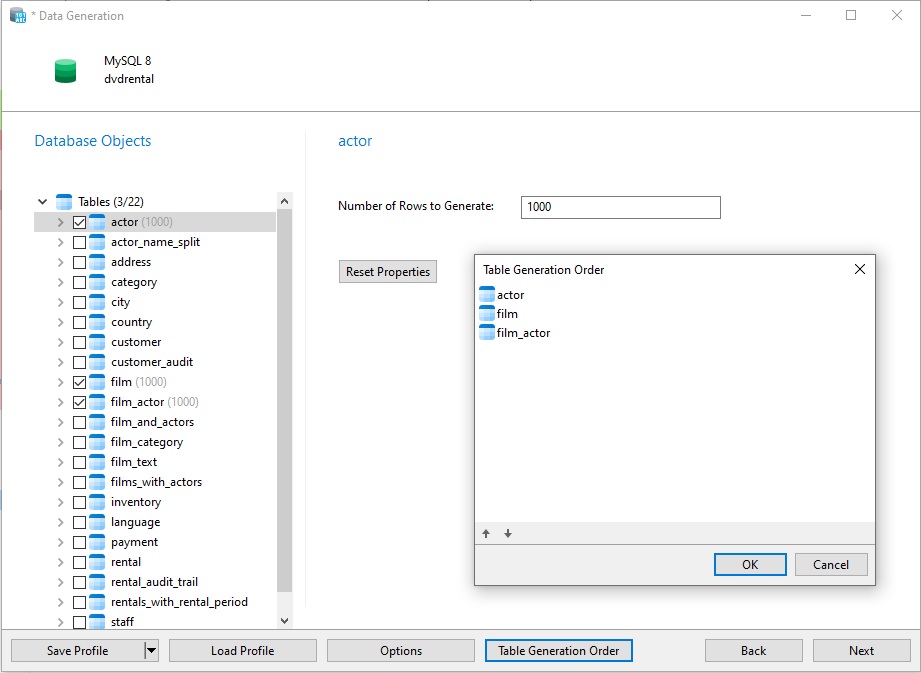
For each column in each selected table, you configure the type of data to generate. Navicat provides generators tailored to common data types and patterns: numeric ranges, date ranges, strings with defined formats, and more. This means the generated values are not just random noise, they reflect the structure and business rules of your schema. You can apply constraints and rules per column to ensure the output matches what your application will actually encounter.
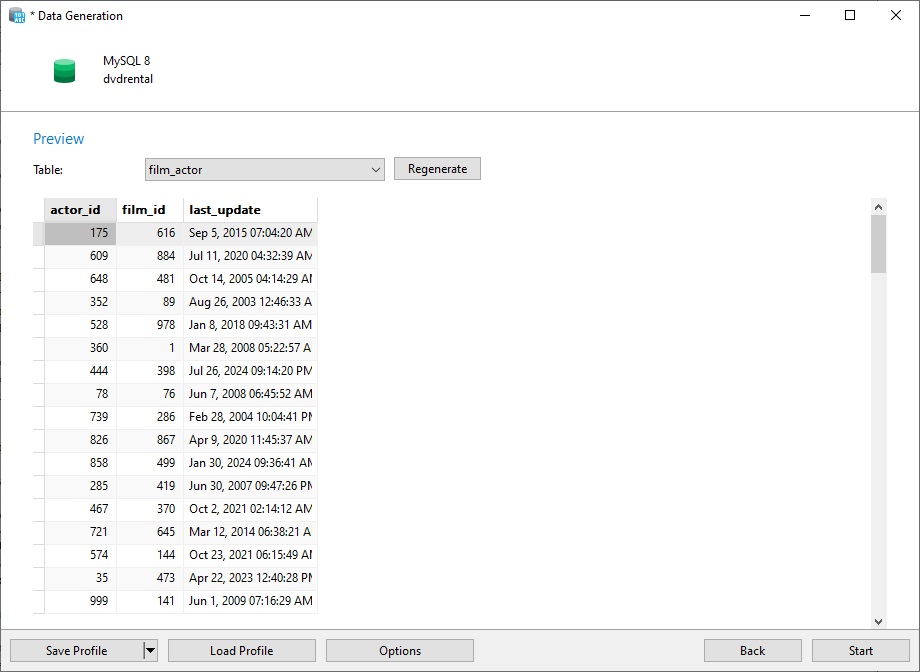
Once the configuration is complete, Navicat displays a detailed preview of the data it intends to generate before writing anything to the database. You can review the values, and regenerate any table's data if it does not look right. This preview step is particularly useful for catching misconfigured generators before they populate a table with thousands of useless rows.
The tool is available across Navicat's supported databases - including MySQL, PostgreSQL, SQL Server, Oracle, MariaDB, SQLite, MongoDB, and Snowflake - and the workflow is consistent regardless of which engine you are targeting. For teams working across multiple database platforms, this means one familiar tool rather than a separate script or utility per database type.
Fitting Data Generation into Your Workflow
Test data generation works best when it is treated as a repeatable, documented step in your development process rather than a one-off task. The ideal setup is a configuration that can be re-run whenever the schema changes or a fresh test environment needs to be seeded. Navicat's Data Generation wizard supports this by letting you save and reuse generation configurations, so the effort invested in setting up the right generators and row counts for your schema is not lost between runs.
A practical workflow is to pair data generation with schema duplication: use Navicat's Structure Synchronization tool to replicate the schema of your production database into a clean test environment, then use the Data Generation tool to populate it with synthetic data. The result is a test environment that mirrors production structurally without containing any of the same data.
Conclusion
Good test data is not a luxury, it is a precondition for tests that actually mean something. Generating it by hand does not scale, and using production data is off the table for most organizations operating under any kind of data privacy regulation. A purpose-built tool like Navicat's Data Generation wizard removes most of the manual overhead: it handles referential integrity, provides per-column control over the type and shape of generated values, shows you a preview before committing anything, and works consistently across the database engines your team is likely to be using. The result is realistic, constraint-respecting test data without the manual effort that usually makes proper test data generation feel like more trouble than it is worth.